
Building-Level EV Power Management: How Charge-M8 Libra Solves Commercial Site Capacity Problems
Commercial sites, fleet depots, workplaces and mixed-use buildings all face the same challenge when they add EV charging: the building's existing electrical supply was never designed for it.
This article answers the questions that facilities managers, fleet operators and project developers most often search for, and explains how the Charge-M8 Libra dynamic load balancer solves each one.
What Is EV Charging Site Capacity and Why Does It Matter?
Every commercial building has a maximum amount of power it can draw from the grid at any moment. When EV chargers are added on top of existing building loads such as lighting, HVAC and equipment, that combined demand can exceed the site's available capacity. This is the core problem behind searches like "site capacity ev charging" and "electrical capacity ev charging".
The risk is not just inconvenience. Exceeding site capacity can trip supply protection, disrupt daily business operations and, in the worst case, damage equipment. For fleet depots and commercial premises where continuous operation matters, this is a real operational and financial exposure.
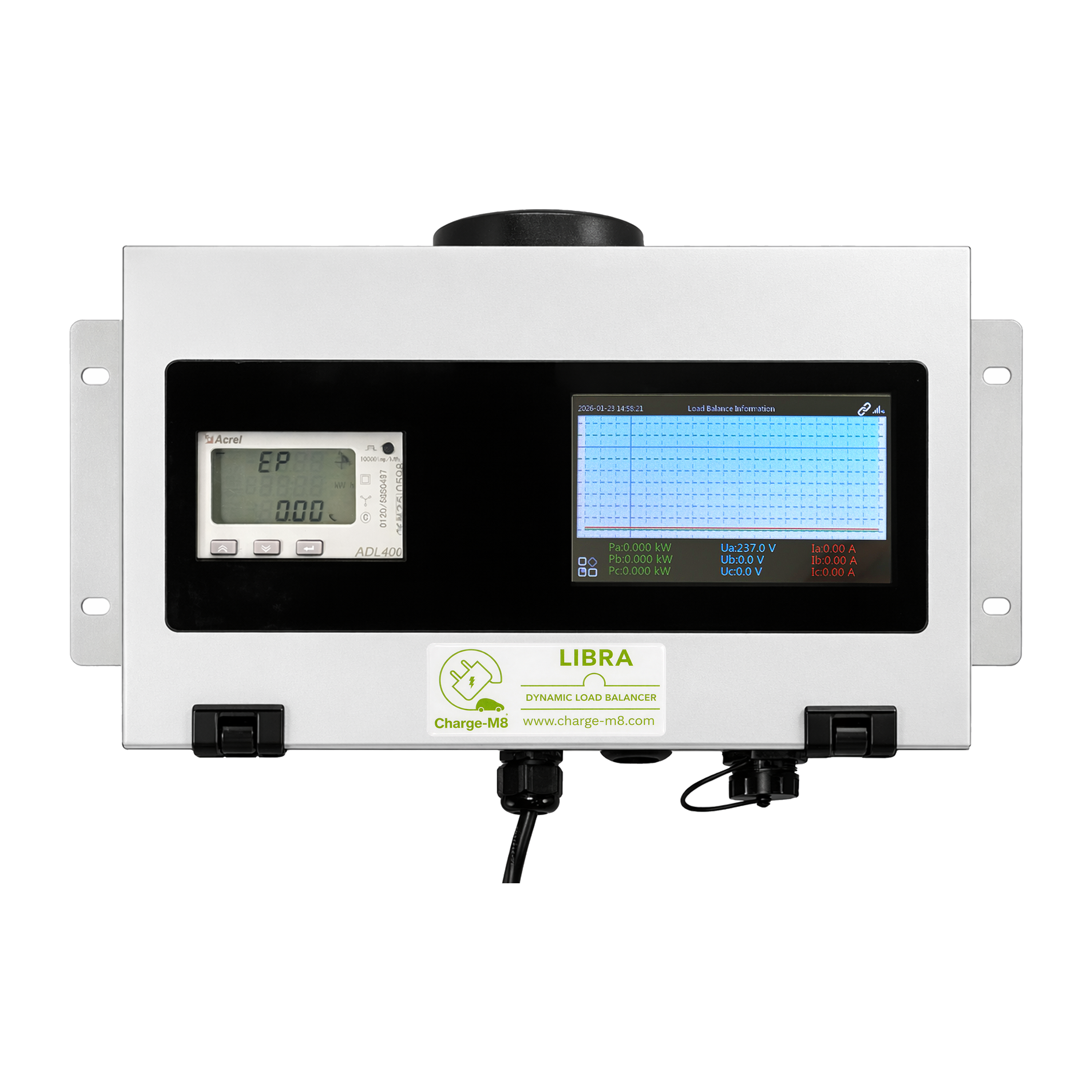
Charge-M8 Libra is a pre-configured dynamic load balancer that continuously monitors a building's power consumption and redistributes available capacity across multiple charge points in real time. Instead of each charger drawing power independently, Libra ensures the site always operates within its actual available capacity.
How Do I Avoid a Costly Grid Upgrade When Adding EV Chargers?
EV charging demand is only going to grow, and UK policy is already acknowledging the pressure this puts on the grid. A UK Government report published on 16 July 2026, the Future of Rural England Report from the Department for Environment, Food & Rural Affairs, notes that network capacity in many areas is constrained, and that installing an EV charge point can itself require upgrades to the local distribution network. Rather than relying only on reactive grid capacity expansion, the report points to Ofgem's approach of supporting "more proactive and anticipatory investment" to accommodate changing demand patterns. In practice, this means businesses cannot assume a grid upgrade will always be quick or straightforward, which makes managing demand within existing supply an increasingly important part of any EV charging rollout.
This is one of the most common concerns for commercial EV projects. Upgrading a supply connection or transformer to accommodate more chargers can be expensive and slow, often involving lead times set by the local distribution network operator.
Libra is built specifically to remove this barrier. It is hardware and OCPP platform agnostic, meaning it integrates into any existing installation without costly infrastructure upgrades. It protects supply capacity while maximising charger availability, allowing businesses to install more chargers on the power they already have, rather than paying for new grid capacity before they need it.
For businesses, fleet operators and developers, this turns EV charging rollout from an infrastructure project into a straightforward equipment installation.
What Is Dynamic Load Balancing and How Does It Prevent Grid Overload?
Dynamic load balancing is the process of continuously measuring how much power a building is actually using, and adjusting how much power is made available to EV chargers in response. This is different from a fixed power allocation, which either wastes capacity when demand is low or risks overload when demand is high.
Libra performs this function in three steps:
Libra constantly monitors the building's power usage.
The power consumption data is sent to the OCPP charge point management platform every few seconds.
The charge points are updated continuously with the available power in response to the building's usage.
This closed loop between the building, Libra and the OCPP management platform is what helps prevent grid overload and the business disruption that comes with it.
How Do I Manage Maximum Demand and Peak Demand With EV Charging?
Maximum demand and peak demand are the moments when a building's total power draw is at its highest, and they are usually what determines whether a site can safely add EV charging without exceeding its supply agreement. Managing peak demand well means chargers keep working during busy periods instead of being switched off or throttled unpredictably.
Because Libra tracks real-time energy demand and available capacity in conjunction with the OCPP charge point management system (CPMS), it allocates charging power dynamically as building demand rises and falls throughout the day. This real-time load capacity balancing keeps the site within its maximum demand limit automatically, without manual intervention from site staff.
How Does Fleet Depot Charging Load Management Work?
Fleet depots and vehicle yards present a concentrated version of the same problem: many vehicles charging on a schedule, within a site that has a fixed power supply. Depot operators searching for "fleet depot charging" or "depot charging load management" are typically trying to solve how to charge more vehicles without exceeding the depot's electrical supply or paying for a grid connection upgrade.
Libra is hardware and platform agnostic, so it works across mixed fleets and multiple charge point brands within the same depot. By balancing load across all connected chargers in real time, it lets depots scale up the number of vehicles they charge without oversizing the electrical infrastructure from day one.
What Is Building Energy Management for EV Charging?
Building energy management for EV charging means treating the building and its chargers as one connected power system, rather than managing chargers in isolation. This is the approach behind terms like "building load management ev charging" and "site power management ev charging".
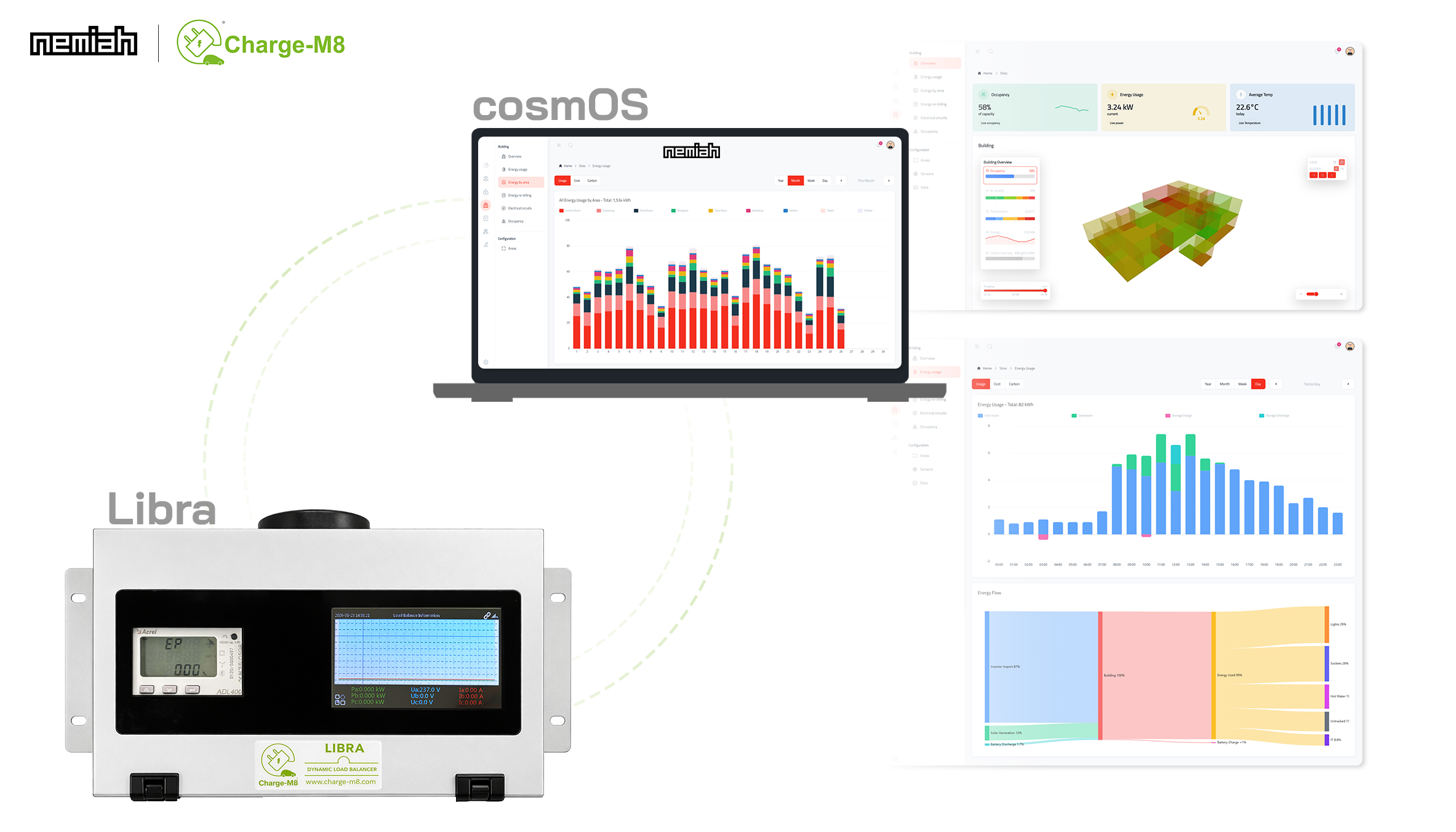
Libra is designed around this principle. It works in conjunction with the OCPP CPMS to track real-time energy demand and available capacity across the whole site, then updates every connected charge point accordingly. The result is a building that can host EV charging alongside its existing operations, with capacity shared intelligently rather than allocated on a first-come, first-served basis.
Is Libra Compatible With My Existing OCPP Platform?
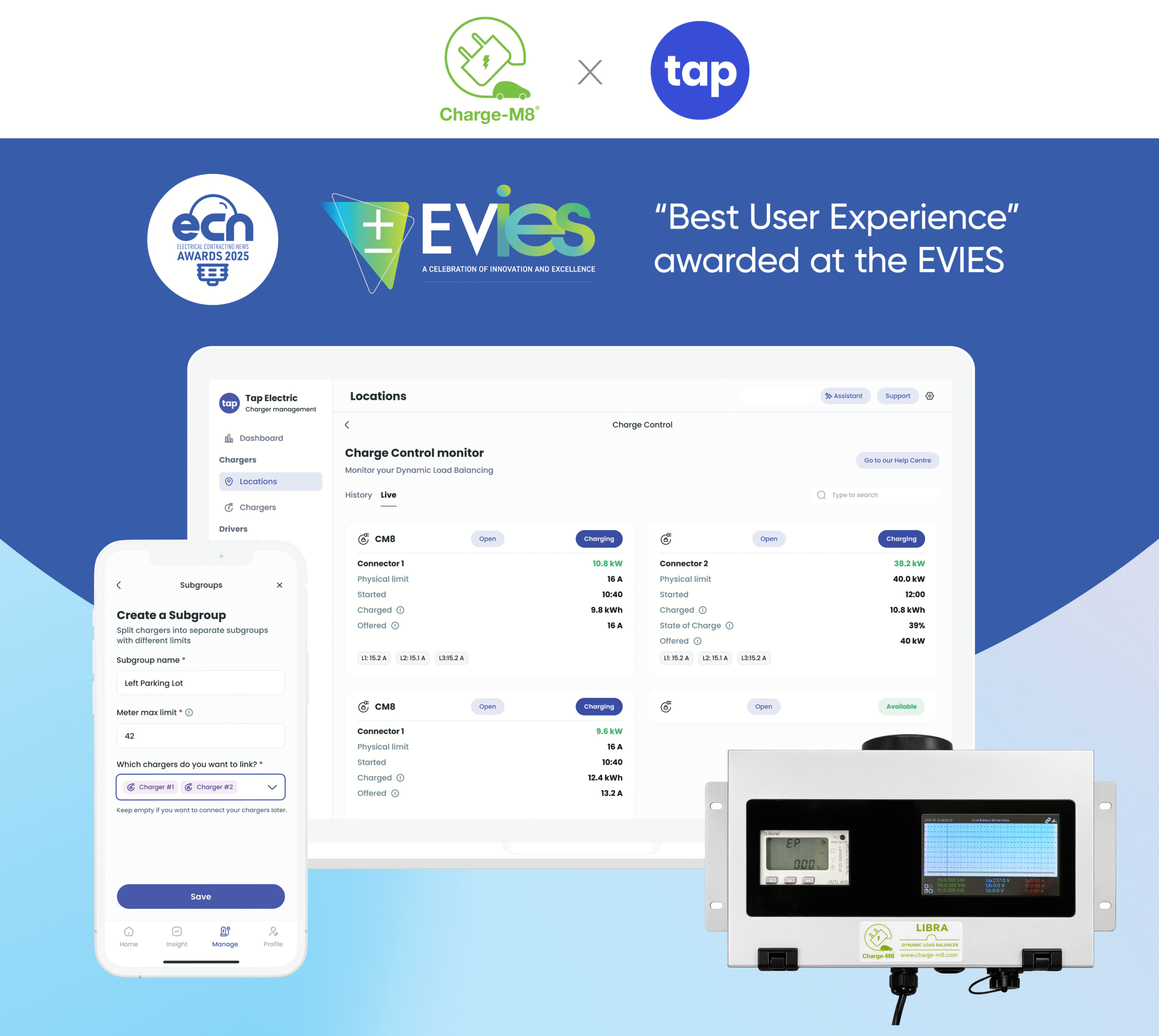
Libra is OCPP 1.6-compliant and designed for direct OCPP platform integration. It is pre-integrated with several major platform partners, including SaasCharge, Tap Electric, Clenergy EV and Nemiah, allowing plug and play deployment without additional development work.
SaasCharge, Tap Electric, Clenergy EV, Nemiah
Plug and play deployment with several major OCPP platform partners, without additional development work.
OCPP 1.6 or Higher
Charge points connected to Libra must be OCPP 1.6 or higher.
One-Time Integration
For OCPP platforms that are not yet pre-integrated, a one-time integration is required.
This platform-agnostic approach means Libra can be added to most existing commercial charging setups without replacing chargers or switching management software.
How Easy Is Libra to Install and Commission?
Installers commission Libra through a 4.3 inch, password-protected touchscreen interface, with no apps or SSID network connections required. Live data is transmitted to the OCPP platform every few seconds, so the system is monitoring and balancing load from the moment it is commissioned.
Libra communicates over 4G or Wi-Fi and is housed in a powder-coated metal enclosure, making it suitable for standard commercial installation environments. Charge-M8 backs the product with a 3-year warranty against manufacturing defects, subject to installation and annual servicing in line with the manufacturer's instructions.
Why Choose Libra Over a Standard Load Balancer?
Most of what appears under generic searches for load balancing or overload prevention is written for household chargers, single-property installations and domestic fuse boards. Commercial sites, fleet depots and multi-tenant buildings have a different problem: multiple charge points, shared building capacity and a genuine cost incentive to avoid a grid upgrade.
Libra is purpose-built for that commercial context:
Talk to Charge-M8 About Your Site
If your business is planning EV charger installation and is concerned about site capacity, maximum demand, or the cost of a grid upgrade, Libra is designed to solve exactly that problem. Contact the Charge-M8 team to discuss how Libra fits your building, depot or development.
Contact Us