
EV charger foundation comparison
EV Charger Foundation Comparison: How to Choose the Right Charger Base for Your Project
Every charge point needs a stable base, and the EV charger foundation you choose affects how long the installation takes, how many site visits it needs and how much of the budget goes on groundworks. For workplace, retail and public charging projects across the UK, the choice usually comes down to wet-pour concrete, a precast concrete block or a modular foundation.
This page compares the three options stage by stage, shows how the Charge-M8 EV Kube modular foundation is installed, and sets out the five EV Kube sizes so you can match the charger base to the equipment on site.
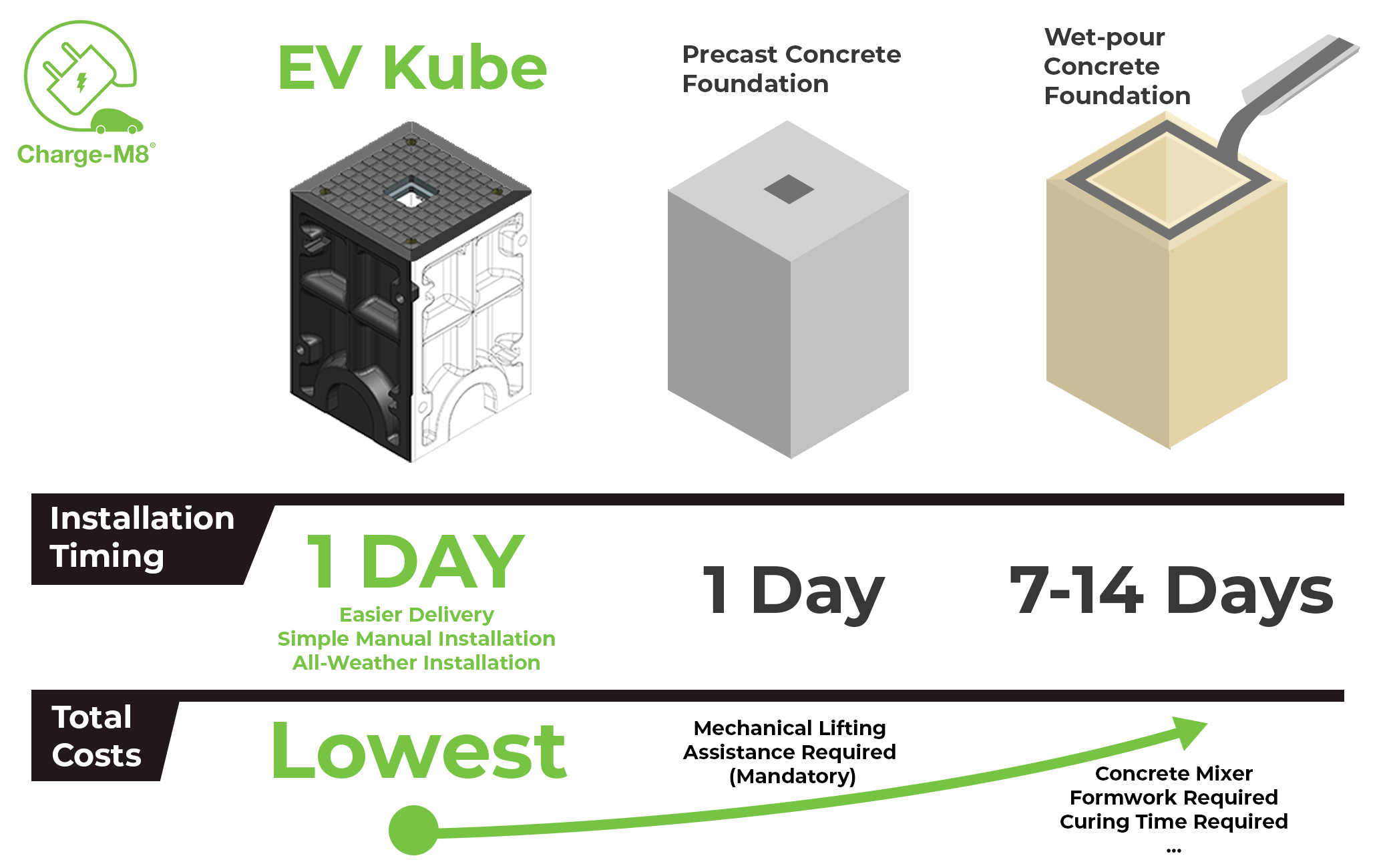
Comparing traditional EV charger foundations with a modular design
Wet-pour concrete has been the default charger base for years. It involves excavation, formwork, a concrete delivery and curing time before the charger can be mounted, which adds labour and leaves the programme at the mercy of the weather. Precast concrete blocks take the pouring and curing off site, but they are heavy, usually need lifting equipment and cannot be sent by parcel courier. Charge-M8 EV Kube is a modular composite foundation that is carried to the trench and assembled by hand. The table below sets the three approaches side by side.
| Feature | Wet-pour concrete | Precast concrete | Charge-M8 EV Kube |
|---|---|---|---|
| One-person installation | No | No | Yes |
| No heavy lifting or concrete mixing equipment required | No | No | Yes |
| No concrete pouring or curing time | No | Yes | Yes |
| Less weather-dependent installation | No | Yes | Yes |
| Single-day installation | No | Yes | Yes |
| Suited to manual handling* | Yes | No | Yes |
| Stackable to suit ground conditions | No | No | Yes |
| Delivery by parcel courier** | No | No | Yes |
| Greater manufacturing consistency | No | No | Yes |
| Recyclable*** | Not applicable | Not applicable | Yes |
- * Every EV Kube component weighs under 20kg, allowing single-person assembly subject to a site-specific risk assessment.
- ** EV Kube is flat-packed and ships as 3 to 5 packages by standard courier, including the largest 600 x 600mm model.
- *** EV Kube's BMC and DMC components can be mechanically recycled through established composite recycling processes.
On multi-site rollouts, the extra stages that concrete brings are usually what make programmes hard to predict.
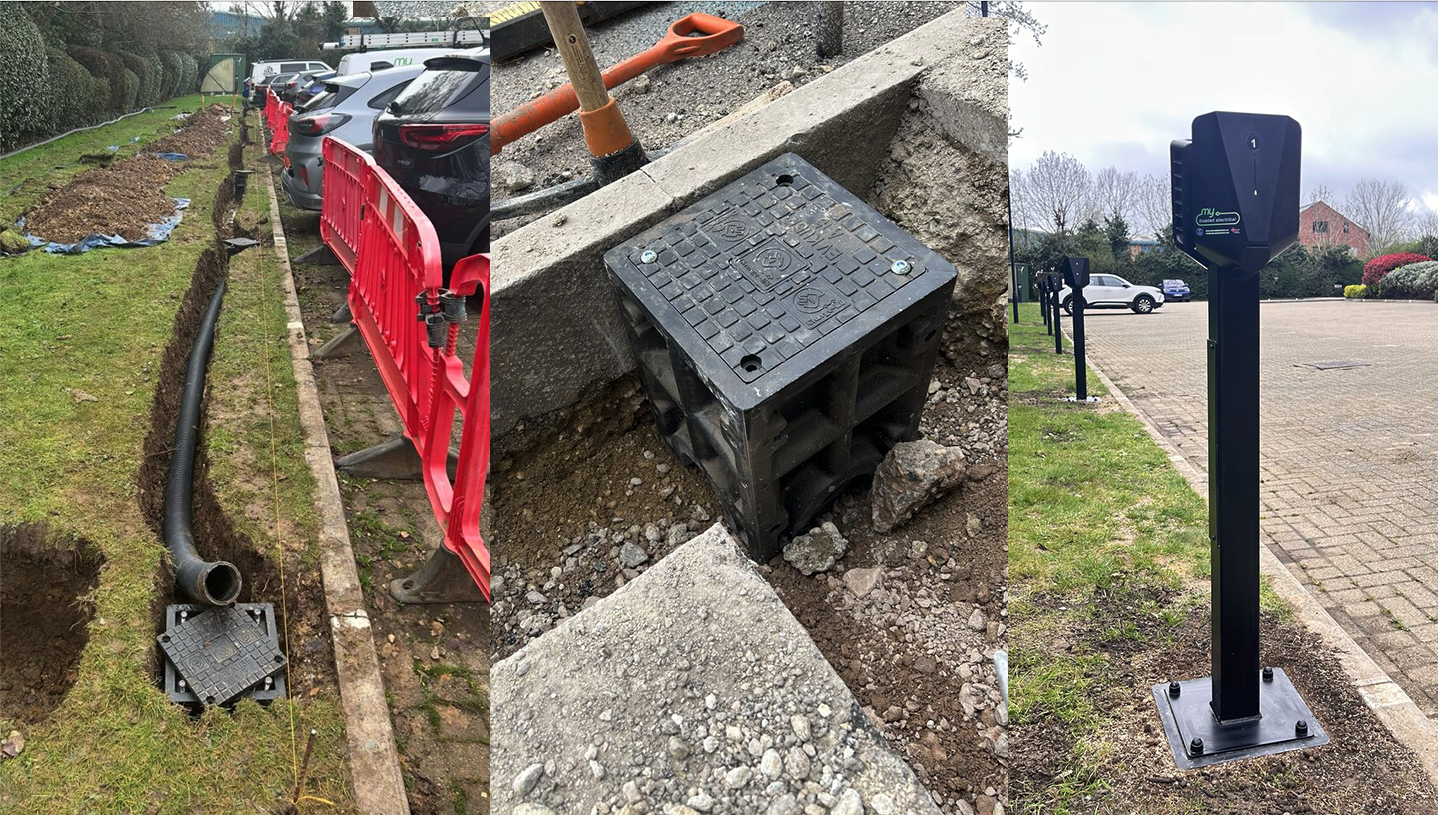
How the EV Kube modular EV charger foundation works
EV Kube replaces wet concrete with a modular composite construction. It arrives flat-packed in courier-sized packages, the panels are bolted together by hand inside the trench, and once backfilled and levelled the foundation can usually be put into use within the same site visit. The full sequence is set out in the EV Kube installation manual (PDF).
Select any label on the diagram to see more detail.

A foundation that would normally take days of groundworks can be set up and ready for a charger in a single day.
Supporting more efficient commercial EV charger installations
Commercial EV charging projects are expected to balance installation speed with long-term reliability. For organisations installing charge points across several locations, these practical differences can add up to a more efficient deployment programme. Real installations are covered in the EV Kube case studies.
Less wet civil work
Reducing wet civil works helps contractors improve scheduling and cut unnecessary site visits.
Repeatable process
A consistent installation process makes multi-site rollouts easier to plan and deliver on time.
Lightweight panels
The lightweight panel design supports safer handling during transport and assembly.
Consistent scheduling
A repeatable installation process helps contractors plan multi-site rollouts with greater confidence.
Five EV Kube foundation sizes to choose from
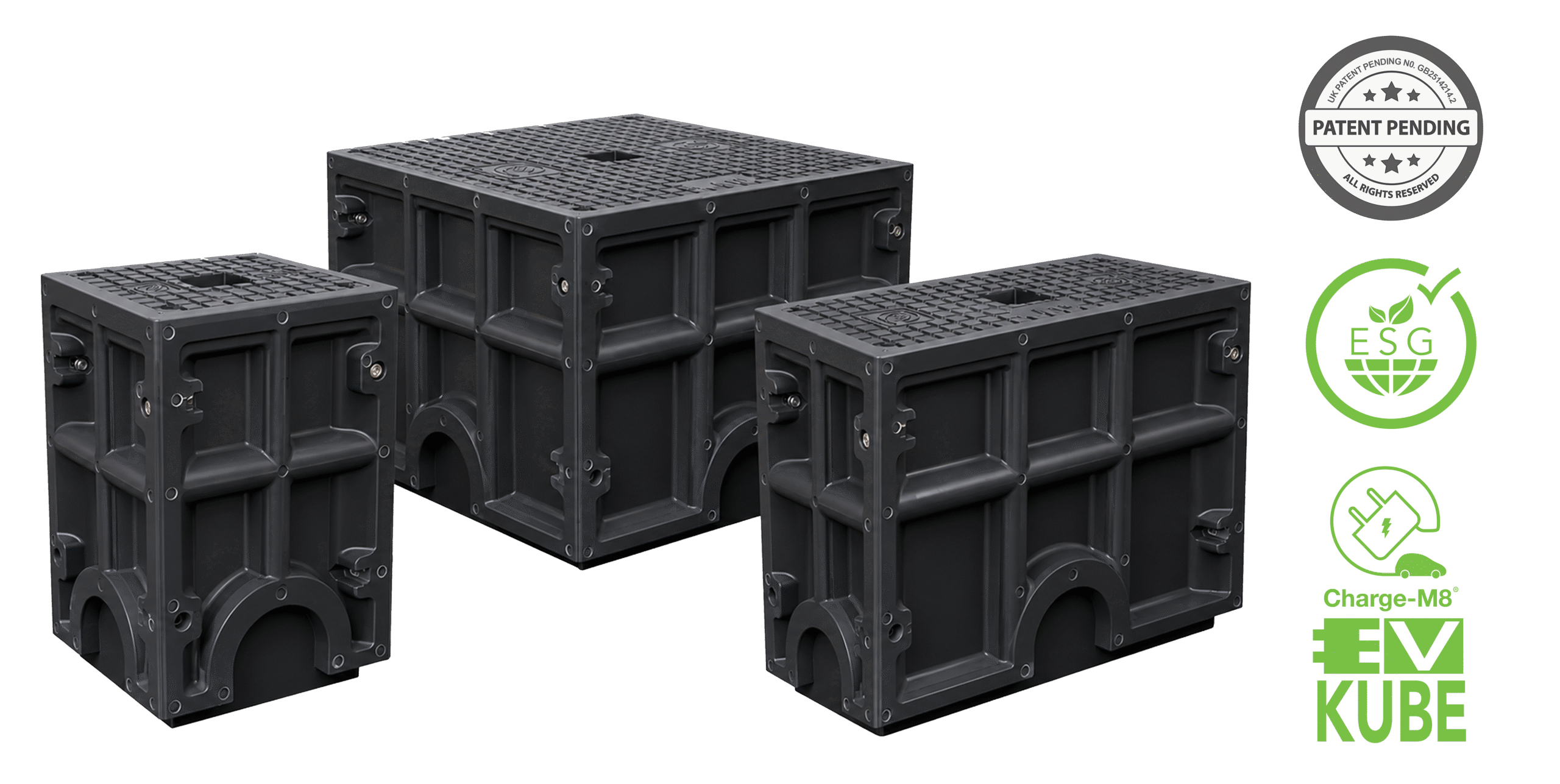
EV Kube comes in five sizes, from the 300 x 300mm Mini for payment terminals and compact chargers to the 600 x 600mm Maxi for pedestal-mounted DC rapid chargers. Select a size to see its dimensions and compatible equipment.

EV charger foundation FAQs
What weight can the EV Kube foundation support?
Every EV Kube size has been tested to meet the A15 loading classification and can support continuous loads of up to 1,500kg, with a peak test load of 2,250kg.
Can an EV charger foundation be installed by one person?
EV Kube is designed so that every individual component weighs less than 20kg, allowing single-person assembly in line with the Charge-M8 installation method, subject to a site-specific risk assessment. Wet-pour and precast concrete foundations normally need more people or lifting equipment.
How long does the EV Kube last?
EV Kube carries a 3 year manufacturer's warranty against manufacturing defects and has an expected service life of more than 10 years, based on a material system with an established track record in outdoor electrical and infrastructure applications.
Is a composite EV charger foundation electrically safe?
The EV Kube composite is non-conductive and provides electrical insulation. BMC and DMC composites have long been used in electrical cabinets and utility enclosures for their dielectric performance and durability.
Is the EV Kube recyclable?
Yes. The BMC and DMC components can be mechanically recycled through established composite recycling processes, as EV Kube contains no internal steel reinforcement. Recovered material can be reused as filler in new composite products or processed as fuel in cement kilns, and the stainless-steel fixings are recyclable where facilities exist.
Choosing the right EV charger base for your project
The right foundation depends on the site, the charger and the programme. Wet-pour concrete and precast blocks are familiar to most contractors, but they bring curing time or heavy lifting with them. A modular EV charger foundation such as EV Kube removes those stages, can be carried and assembled by one person, and comes in five sizes to suit equipment from payment terminals to DC rapid chargers.
If you are planning a commercial charge point installation, the EV Kube product page has the installation manual, size guidance and case studies in one place.
Planning a commercial EV charging project
See how Charge-M8 EV Kube can shorten installation time with a modular, concrete-free foundation for EV charging infrastructure.
Note: Final installation design should always follow the relevant engineering specification and Charge-M8 installation guidance.