
A Modular and Sustainable Composite EV Charger Foundation: The Concrete Alternative in 2026
EV Kube is a modular composite EV charger foundation, built from Bulk Moulding Compound (BMC), engineered as a sustainable concrete alternative for EV charging infrastructure and independently tested by The University of Manchester's Department of Mechanical & Aerospace Engineering, not just described in a brochure.
Every figure on this page is a product-specific fact about this composite EV charger foundation: material composition, third-party test results, or Charge-M8's own operational programme.
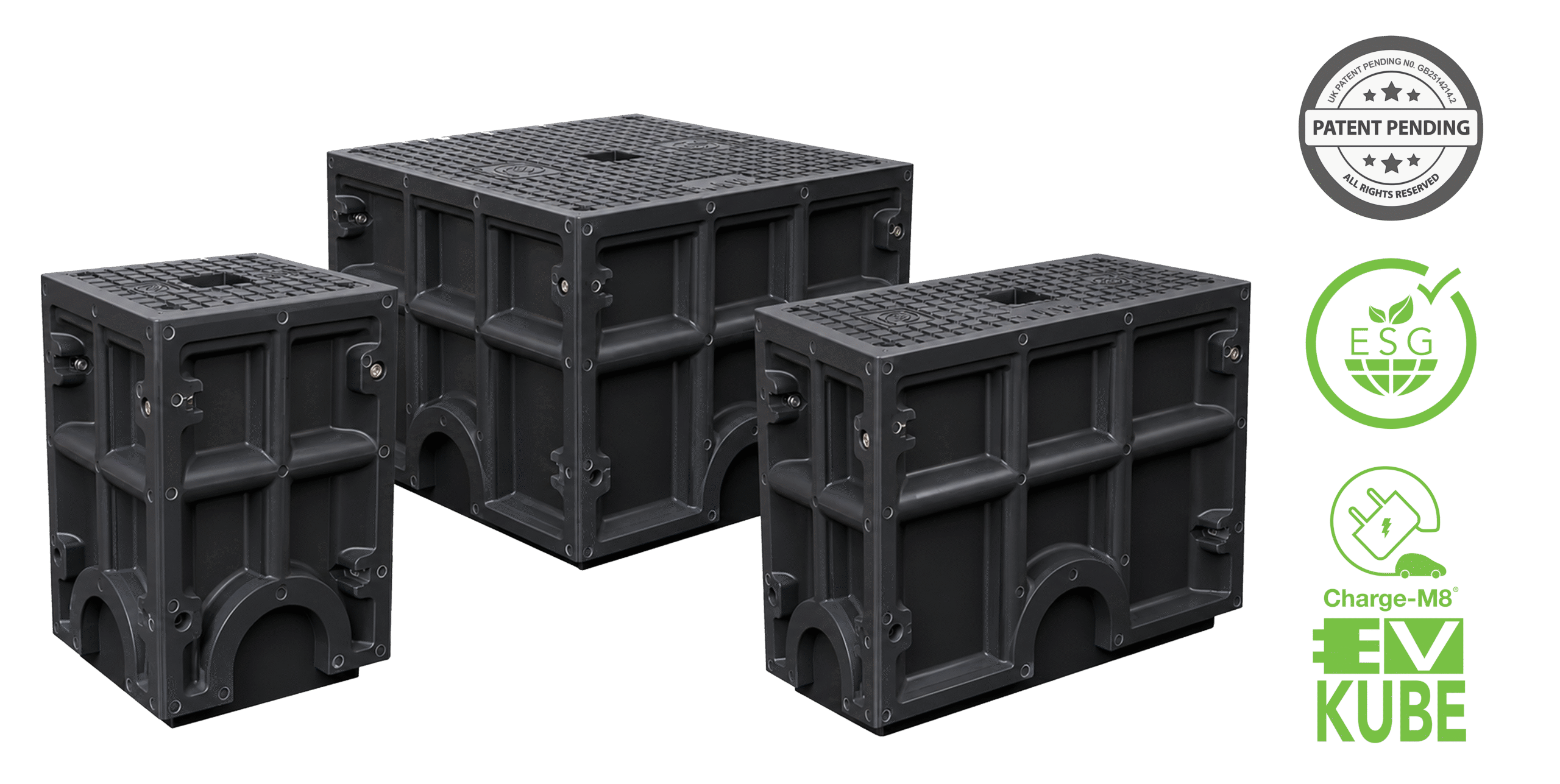
What Makes EV Kube a Sustainable Composite EV Charger Foundation
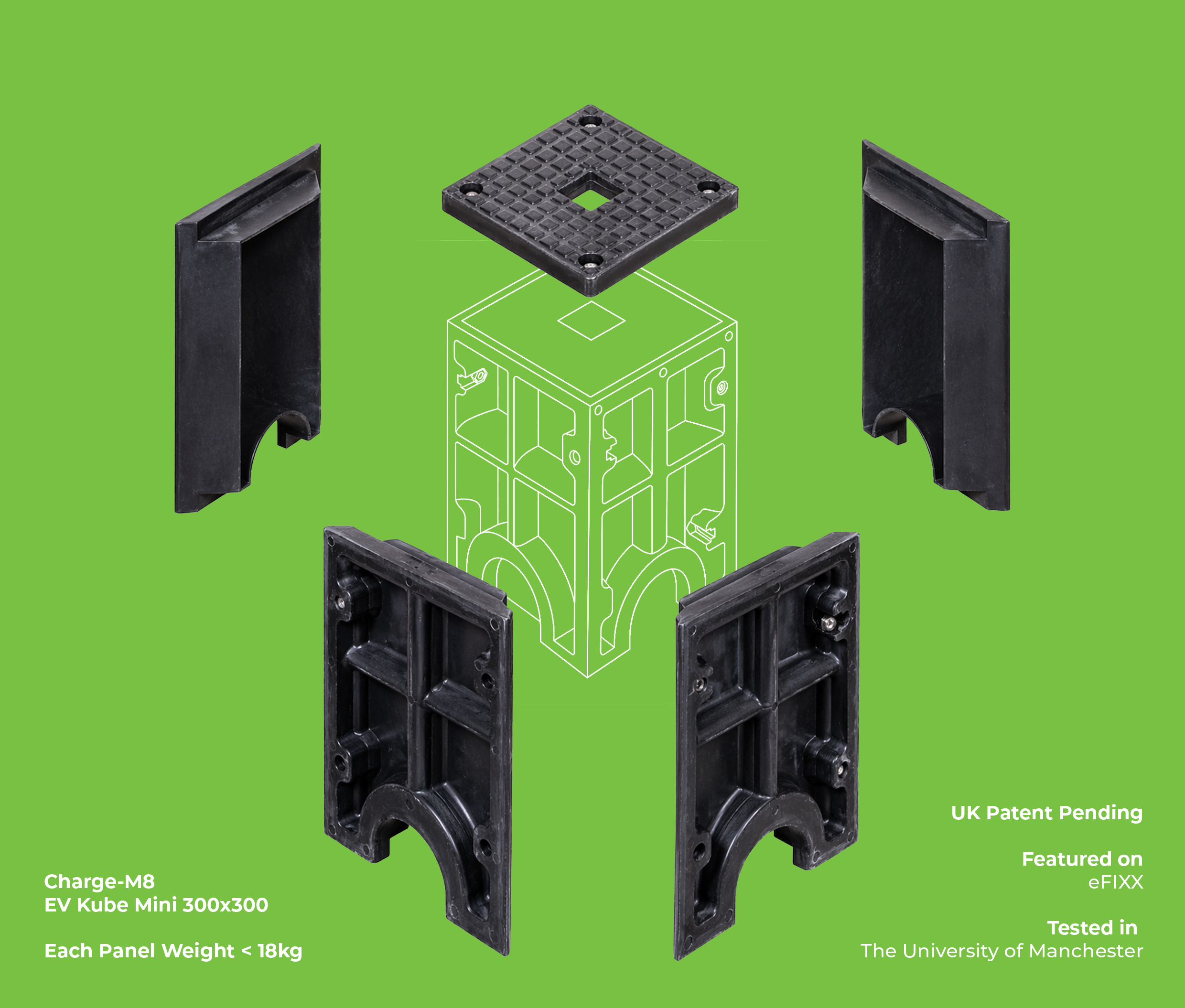
EV Kube's modular design starts with the material. The four side panels of this composite EV charger foundation are moulded from Bulk Moulding Compound (BMC), a sustainable alternative to concrete that doesn't rely on wet-pour or curing. The top cover uses Dough Moulded Compound (DMC), chosen for surface finish and dielectric performance. Both are thermosetting composites that don't soften, creep or corrode outdoors, which is central to EV Kube's case as a durable concrete alternative.
Ground Stability: How This Composite EV Charger Foundation Performs Against Wind and Soil Movement
Ground heave and soil movement are site-specific risks that every installer must assess before backfilling any EV charger foundation. The EV Kube Installation Manual requires this explicitly. As part of making EV Kube a credible, sustainable concrete alternative, The University of Manchester independently tested overturning resistance across five backfill and soil combinations. Concrete backfill, clay soil performed best.
All configurations adequate
Concrete-based backfills and the combined MOT 1 with Postcrete method provide adequate overturning resistance across all three foundation sizes at the conservative 67 m/s design-speed baseline.
Factor of safety, dry ground
Even the smallest, most exposed foundation (470-0300 on MOT 1 backfill) shows a comfortable stability margin in dry conditions, with mean/peak factors of safety of approx. 1.87–1.96 and 1.68–1.93.
Stability under half-submersion
Stability is maintained with reduced margin under half-submerged groundwater. Full submersion is the limiting condition. The study recommends drainage or equivalent site mitigation to preserve the safety margin.
Independently Verified: Why This Modular Composite Foundation Is a Credible Concrete Alternative
Two consultancy studies were commissioned from The University of Manchester's School of Engineering, covering all three Charge-M8 470-series models of this modular composite EV charger foundation. This is product-specific testing, not category-level literature. It shows that EV Kube, as a BMC composite foundation, holds up reliably once installed on real sites, making it a strong fit for building EV charging infrastructure in a more sustainable way.
Wind loading methodology
Reference wind speeds and passive earth pressure theory applied across three backfill methods and two soil types, with and without groundwater.
Vehicular impact resistance
Assessed against BS 7671 (Appendix 5, Clause 8.10). All three models met IK08 across every backfill method; all except the smallest on MOT 1-only also met IK10.
Computational fluid dynamics follow-up
A higher-fidelity CFD study resolved realistic wind flow and turbulence. Its overturning demand came out lower than the first study, confirming the original assessment was conservative.
EV Kube vs. Concrete: What a Modular Composite EV Charger Foundation Changes on Site
A plain description of what each installation method requires, so you can see exactly why a modular composite EV charger foundation is a practical concrete alternative. This is Charge-M8's own installation-method comparison, not third-party benchmarking.
| Requirement | Wet-pour concrete block | Precast concrete block | EV Kube |
|---|---|---|---|
| Installed by one person | No | No | Yes* |
| No cranes or mixing plant needed | No | No | Yes |
| Side panels feature curves designed to help resist ground heave | No | No | Yes |
| Independently tested for wind and impact resistance | No | No | Yes |
| No curing period before load-bearing | No | Yes | Yes |
| No weather-related delay risk | No | Yes | Yes |
| Typical one-day installation | No | Yes | Yes |
| Panels within manual handling guidance (<20kg) | - (N/A) | No | Yes |
| Adjustable stacking for ground conditions | No | No | Yes |
| Delivered by standard courier, no pallet gear | No | No | Yes |
| Mechanically recyclable at end of life | No | No | Yes |
*Small model. Medium and large models may need additional personnel depending on site conditions.
Learn more about EV KubeOur EV Kube Recycling Scheme: What Makes This Composite Foundation a Sustainable Concrete Alternative
Sustainability doesn't stop at installation. This modular composite EV charger foundation is designed to leave the ground the way it came, in pieces that can be recovered through Charge-M8's own recycling scheme, not a slab of concrete that gets landfilled.
Recycling Scheme
Retired units are collected under Charge-M8's Return-to-Depot Recycling Scheme.
Mechanical recycling
BMC and DMC components are crushed and reprocessed through approved manufacturing routes.
Reintroduced as filler
Current processes allow up to 15% recycled composite content back into new production without loss of strength.
ESG-Aligned Design
EV Kube is designed to reduce manual handling risk for installers and lower disruption to the local community and environment around every site.
Frequently Asked Questions About EV Kube, the Sustainable Composite EV Charger Foundation
Q1.Why is EV Kube described as a concrete alternative for 2026?
EV Kube is a modular composite EV charger foundation that removes wet-pour concrete, precast blocks, curing periods and heavy lifting equipment from an installation. As EV charging rollouts scale up in 2026, that combination of speed, lighter logistics and recyclability is why it's positioned as a sustainable concrete alternative rather than a like-for-like substitute.
Q2.What material is the Charge-M8 EV Kube made from?
The four side panels are moulded from Bulk Moulding Compound (BMC): 30% unsaturated polyester resin, 26% fibreglass reinforcement, 34% calcium carbonate filler, and 10% processing additives. The top cover is Dough Moulded Compound (DMC).
Q3.How is ground stability verified?
The University of Manchester assessed overturning resistance for all three foundation sizes across five backfill/soil combinations at wind speeds up to 67 m/s. Site-specific ground heave and drainage risk assessment remains the installer's responsibility per the Installation Manual.
Q4.What impact rating does the EV Kube meet?
All three foundation models met the IK08 rating required by BS 7671 for publicly accessible EV charging equipment across every backfill method tested. Most configurations also met IK10.
Q5.Can one person install the EV Kube?
The largest individual panel weighs under 18 kg, within UK manual handling guidance. The small model can typically be assembled by a single installer without cranes or lifting equipment, subject to site-specific risk assessment.
Q6.Is the EV Kube recyclable?
Yes. BMC and DMC components can be mechanically recycled, current manufacturing allows up to 15% recycled composite reintroduction, and Charge-M8's Return-to-Depot scheme provides a Recycling Certificate for customers' ESG reporting.