
9 February, 2026
Traditional Concrete vs Modular EV Charger Foundations
When installing EV charging infrastructure, contractors face a choice between traditional wet pour concrete foundations and innovative modular systems like the Charge-M8 EV Kube. Here we examine why contractors may choose either solution, and the implications for project costs and deployment timelines.
Traditional Concrete EV Charger Foundations
The most common installation method remains the wet pour concrete foundation: a technique contractors have relied upon for decades. Whilst proven and familiar, this approach introduces challenges that frequently cause delays and escalate project costs.
- Curing period requires multiple site visits, installations extend between 7 and 28 days depending on weather conditions
- Winter installations face particular difficulties, low temperatures prevent proper curing and compromise structural integrity
- Requires palletised delivery, forklift access, concrete mixer trucks, and specialist contractors
- Constrained urban locations, car parks, and remote sites are particularly challenging to service
- Additional risks include animal interference during curing, accidental damage to uncured concrete, and inconsistent dimensions from wooden shuttering
The concrete curing period necessitates multiple site visits — and in cold or wet British weather, a single installation can stretch to a week or more before a charger can safely be mounted.
Charge-M8 EV Kube: Modular and Environmentally Friendly
The alternative to traditional methods is a modular foundation system that eliminates wet concrete entirely. The Charge-M8 EV Kube is engineered for same-day installation.
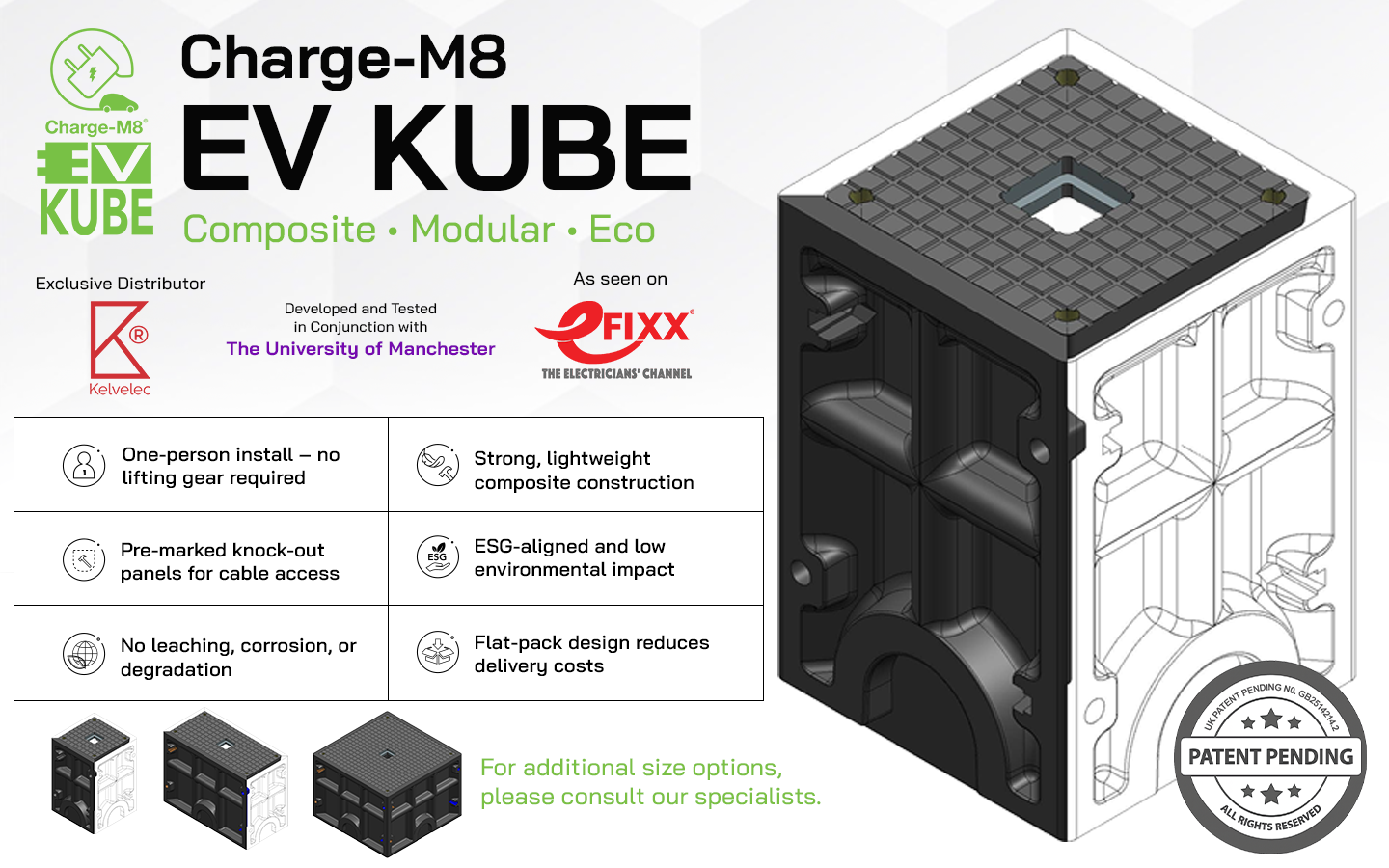
- Contractors excavate the required depth, position the modular base, and connect the charging equipment: all within a single site visit
- Flat-pack design enables courier delivery directly to sites, removing the need for cranes or forklifts
- Components designed for manual handling: installation without heavy lifting equipment
- Consistent, predictable installations regardless of weather conditions
- Non-conductive composite construction provides electrical safety benefits crucial for high-power charging infrastructure
- Mounting system adapts to different charger models as technology evolves
Learn More
Discover how EV Kube can reduce installation time and total project cost for your EV charging infrastructure.
EV Charger Foundations Comparison
How the two foundation approaches stack up across the factors that matter most to contractors:
Traditional Concrete
- Specialist haulage & forklift required
- 2–5 workers on site
- Mixer, formwork & plant hire needed
- 7–28 day curing period
- Multiple site visits required
- Weather-dependent scheduling
- High CO₂ from cement production
- Non-recyclable waste material
Charge-M8 EV Kube
- Standard courier delivery
- Single installer, no machinery
- Zero equipment hire
- No curing, structurally stable in minutes
- Charger live the same day
- All-weather installation
- No cement, significantly lower CO₂
- Recyclable composite materials
Cost Comparison
Traditional concrete costs comprise materials, formwork, concrete supply, curing time, and multiple contractor visits. Projects must budget for weather delays and extended site occupation.
Modular foundation costs include the system itself plus single-visit installation labour. Whilst initial costs may appear comparable, the total project cost shifts significantly when factoring in:
- Elimination of multi-day site occupation
- Removal of weather-related delays
- Reduced labour hours across the project
- Immediate commissioning enabling faster revenue generation
For multi-site rollouts, these advantages compound significantly — faster installation per site means faster revenue per charger across the entire network.
Three Decisive Advantages of Modular Foundations
With comparable upfront costs, the choice between foundation types balances familiarity against performance. Contractors choosing the Charge-M8 EV Kube gain:
Manual Installation
Flat-pack delivery and sub-20 kg components enable single-person assembly, eliminating cranes, forklifts, and specialist plant entirely.
Rapid Deployment
Same-day installation works with industry-standard charging posts, payment terminals, and AC/DC equipment across multiple sites simultaneously.
Durable & Sustainable
Non-conductive, corrosion-resistant composites deliver decades of performance whilst eliminating concrete's environmental impact.
Built for the UK's EV Expansion
As the UK's EV charging network expands to meet 2030 targets, the infrastructure enabling rapid, reliable deployment will prove as critical as the chargers themselves.
The Charge-M8 EV Kube removes the barriers that have historically slowed EV infrastructure rollout — delivering a foundation that is structurally proven, fast to install, and built for the demands of a growing network.
Ready to upgrade your installation approach?
Get in touch with the Charge-M8 team to discuss your project or request product data sheets.